
Contact Us
Welcome to contact Hangzhou Zansong Digital Co., Ltd.
89 Trends in Livestream Sales Audio Equipment in Vietnam (2026): Solutions for Live Hosts
Discover the trends in audio equipment for livestreaming sales in Vietnam in 2026 and how to choose the right sound card and wireless microphone for your Live Stream Host.
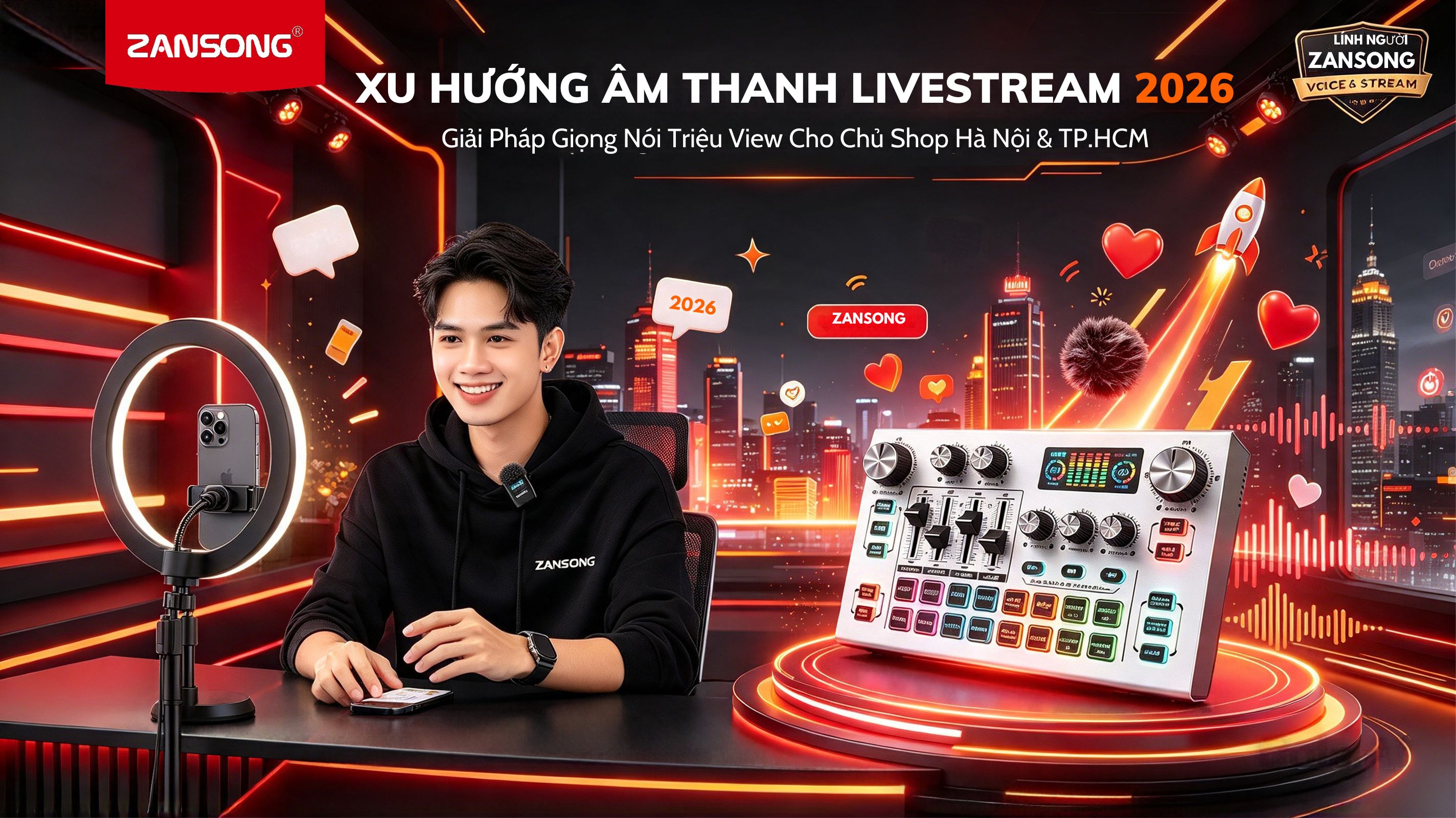
Live selling is becoming an essential part of online business in Vietnam. From fashion shops, cosmetics, and household items to individual sellers and content creators, livestreaming helps brands interact directly with customers, introduce products, and drive purchase decisions right during the broadcast.
In vibrant e-commerce markets like Ho Chi Minh City and Hanoi, the variety of live sessions is growing rapidly. Since viewers can switch to another stream in just a few seconds, image and audio quality have become critical factors in retaining attention.
Among these, clear, stable, and low-noise livestream audio plays a key role in creating a more professional viewing experience.
So, what are the trends in live selling audio equipment in Vietnam for 2026? Should stream hosts choose a sound card or a wireless microphone? And how can the ZANSONG audio equipment ecosystem support these needs?
1. Why Audio Is Becoming Increasingly Important in Live Selling
During a livestream, viewers do not just look at products; they continuously listen to the host's voice.
A live session with great visuals but soft, noisy, or unstable audio can ruin the viewing experience.
Especially in live selling, hosts often have to multitask simultaneously:
-
Introducing products.
-
Providing advice on features and specifications.
-
Reading customer comments.
-
Answering questions.
-
Encouraging orders.
-
Moving around or grabbing products.
-
Playing background music and setting the mood for the stream.
This demands an audio system that is simple, flexible, and user-friendly.
At shops in Ho Chi Minh City, the streaming environment could be a studio, a storefront, or a warehouse. Meanwhile, hosts in Hanoi may stream from retail stores, private rooms, or combined business-warehouse spaces.
Each environment presents different demands for audio pickup and processing capabilities.
2. Common Audio Issues During Live Selling
2.1. Ambient Noise
Livestreaming in a store or warehouse is usually not a soundproof environment.
Traffic noise, fans, air conditioners, staff packing orders, or surrounding chatter can all bleed into the microphone.
As a result, the host's voice easily gets drowned out by background sound.
This is why noise cancellation capabilities are increasingly prioritized by livestreamers.
2.2. Audio and Video Desynchronization
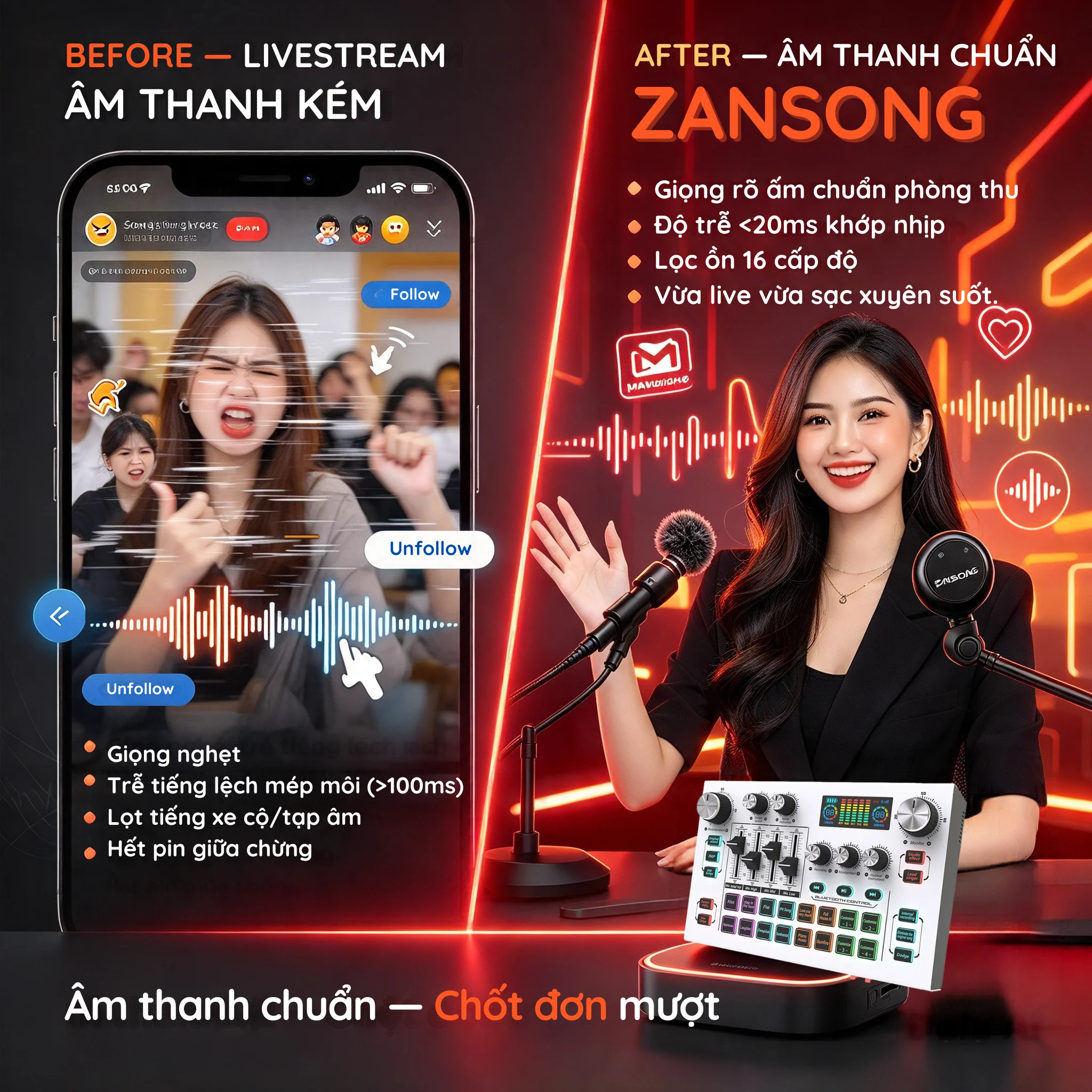
Another common issue with wireless devices is signal latency.
If the audio reaches the processor or phone slower than the video, lip movement and voice won't be perfectly synchronized.
In professional live selling sessions, seamless audio-video sync creates a much more natural viewing experience.
2.3. Overly Complex Equipment
Not every stream host possesses in-depth audio knowledge.
A sound card with too many knobs or complicated connection setups can overwhelm beginners and waste setup time.
Therefore, a notable current trend is audio gear focused on simple operation and streamlined core features.
2.4. Speaking for Extended Periods
A single live session can last for hours.
Hosts must continuously speak, present products, and engage with viewers. Thus, an audio system that renders vocal clarity and easy adjustment helps hosts maintain control throughout the broadcast.
3. Three Live Selling Audio Equipment Trends in 2026
3.1. Simpler Sound Cards and Audio Processors
Previously, sound cards were often viewed as devices for those with technical audio expertise.
However, the demands of live selling are reshaping how these devices are designed.
Instead of requiring users to adjust countless parameters, new trends prioritize quick-access functions such as:
-
Noise cancellation.
-
Microphone volume control.
-
Background music volume control.
-
Reverb effects.
-
Music ducking when the host speaks.
-
Direct connection to smartphones or computers.
The goal is to help hosts focus on selling and engaging with customers rather than constantly troubleshooting technical issues.
3.2. Compact Wireless Microphones for Mobile Livestreaming
Live selling is no longer restricted to a fixed position.
Hosts may talk to the camera while picking products, trying on clothes, demonstrating inventory in warehouses, or moving between store sections.
Therefore, wireless lavalier microphones are becoming essential for scenarios requiring high mobility.
Compared to wired mics, wireless equipment reduces cable clutter around the set.
Some next-gen wireless mics also feature built-in noise reduction and charging cases, offering greater convenience for marathon live sessions.
3.3. Direct Smartphone Connectivity
Smartphones remain one of the most popular tools for livestreaming.
Thus, direct smartphone compatibility is a key criterion when choosing live audio gear.
Connection standards like Type-C, Lightning, or OTG streamline the setup and eliminate unnecessary adapters.
In particular, for hosts streaming on smartphones, the ability to use a mic while simultaneously charging the device ensures uninterrupted long broadcasts.
4. ZANSONG Livestream Audio Ecosystem
To cater to diverse livestreaming requirements, ZANSONG has developed two product lineups aimed at content creation and online selling:
ZANSONG STREAM
Sound cards designed for livestreaming and content creation.
ZANSONG VOICE
Wireless lavalier microphones for recording, livestreaming, and video shooting.
These two product categories can be used independently or combined depending on each host's setup.
5. Sound Cards for Stream Hosts
The ZANSONG STREAM series is tailored for streamers, TikTokers, content creators, and live sellers.
One featured model is the ZANSONG X5.
According to product specifications, the X5 features:
-
XLR port with 48V phantom power support.
-
2 digital Type-C OTG ports for livestreaming.
-
2 x 3.5mm livestream ports.
-
6.35mm dynamic microphone port.
-
6.35mm instrument input port.
-
Bluetooth background music playback.
-
Low/Mid/High EQ control for microphones.
-
Reverb control.
-
Volume controls for microphone, background music, and monitoring.
-
Noise reduction and music ducking functions (depending on configuration).
A key highlight is that the system allows users to actively control multiple audio sources within a single device.
For live sellers, this is exceptionally useful when streams involve vocals, background music, and other audio inputs simultaneously.
6. Wireless Lavalier Microphones for Mobile Hosts
While sound cards suit stationary livestream setups, ZANSONG VOICE wireless lavalier microphones target requirements for high flexibility.
Models such as the K31, K32, K50, and ST88 are designed for users who frequently record videos or stream using smartphones.
Key features include:
Omnidirectional Pickup
Omnidirectional mic patterns capture voice evenly even when the host isn't standing directly fixed in front of the camera.
This is extremely useful when hosts turn around, grab products, or move around the shop floor.
Low Latency
Low-latency signal transmission reduces audio-video sync delays during recording and streaming.
Plug & Play
Designed for fast connection with compatible devices, perfect for sellers who don't want to spend time setting up complex systems.
Charging Case
The charging case protects the mic while recharging it between live streaming sessions.
7. Ideal Livestream Setup for Shops in Hanoi and Ho Chi Minh City
There is no single audio setup that fits every seller.
The choice should be based on space, streaming style, and host mobility.
Setup 1: Fixed Livestream in Studio or Store
Suitable for:
-
Fashion shops.
-
Cosmetics.
-
Electronics.
-
Retail brands.
-
Product showcase streams.
Suggested Configuration:
Professional Microphone → ZANSONG X5/X7 → Smartphone or PC → Livestream Platform
This configuration works best when the host sits or stands in a relatively fixed spot and needs precise control over multiple audio elements.
Setup 2: Mobile Livestream in Shop or Warehouse
Suitable for:
-
Household goods shops.
-
Warehouses.
-
Fashion streams.
-
Direct live selling.
-
Hosts on the move.
Suggested Configuration:
ZANSONG VOICE Wireless Microphone → Smartphone → Livestream Platform
The advantage of this setup lies in its simplicity and mobility.
The host can move around the streaming area without dragging long mic cables.
8. Should Vietnamese Stream Hosts Choose a Sound Card or Wireless Mic?
The answer depends on how you stream.
| Needs / Criteria | Sound Card | Wireless Microphone |
|---|---|---|
| Fixed Livestream | ✓ Suitable | ✓ |
| Mobile Host | △ | ✓ Suitable |
| Audio Adjustments | ✓ Versatile Controls | △ |
| Professional Mic Connection | ✓ | △ |
| Fast Setup | △ | ✓ |
| Smartphone Livestreaming | ✓ | ✓ |
| Background Music Playback | ✓ | △ |
| Beginner Friendly | Model dependent | ✓ |
If you are a stationary stream host wanting full control over vocals, background music, and audio effects, a sound card offers more versatility.
If you prioritize compactness, quick operation, and mobility, a wireless lavalier mic is likely the more convenient choice.
9. Tips for Choosing Live Selling Audio Equipment in Vietnam
Before buying equipment, hosts should clearly evaluate four factors:
1. Which device do you stream with?
Smartphone, PC, or both?
2. What is your streaming environment like?
Enclosed room, studio, shop, or warehouse?
3. Do you move around frequently?
If yes, wireless microphones offer much greater flexibility.
4. What level of audio control do you require?
If you only need vocal pickup, a wireless mic is a simple solution.
If you need to manage multiple audio sources, background music, and effects, a sound card is more suitable.
10. Buying Authentic ZANSONG Live Audio Gear in Vietnam
As the livestreaming market grows, the range of audio devices tailored for sellers continues to expand.
When choosing a product, users should carefully verify:
-
Product origin and authenticity.
-
Model and technical specifications.
-
Included accessories.
-
Compatibility with smartphones or computers.
-
Warranty policy.
-
After-sales support network.
For sellers in Hanoi, Ho Chi Minh City, and other provinces, opting for authentic products backed by clear support policies ensures a smoother long-term experience.
Conclusion: Audio Is an Essential Part of the Sales Experience
In 2026, live selling in Vietnam continues to evolve towards professionalism, flexibility, and viewer experience optimization.
In this trend, audio equipment is no longer just a camera accessory. A suitable system helps hosts master vocal delivery, minimize noise, and deliver a more stable listening experience for customers.
With the ZANSONG STREAM and ZANSONG VOICE ecosystems, sellers can choose between sound cards and wireless microphones based on their actual streaming workflow.
ZANSONG X5/X7 suit setups demanding extensive audio control, whereas ZANSONG K31, K32, K50, and ST88 focus on compact flexibility with smartphones.
Whether you operate a livestream studio in Ho Chi Minh City, a store in Hanoi, or start streaming from a small shop, the golden rule remains: choose equipment that fits how you sell, not just the one with the most features.
A professional livestream starts with many elements — and clear, stable audio is one of the key foundations for hosts to connect with customers.
